Viking Range Repair
Why a Viking Range Burns Tall and Orange in Denver
Written by
Owen Castellanos
Service technician — doors, hinges and cabinet work · 12 years in the trade
A Viking burner with a long orange flame that soots pan bottoms is usually metered for sea level, not broken. How to tell an altitude setup fault from a real burner problem before you pay for parts.
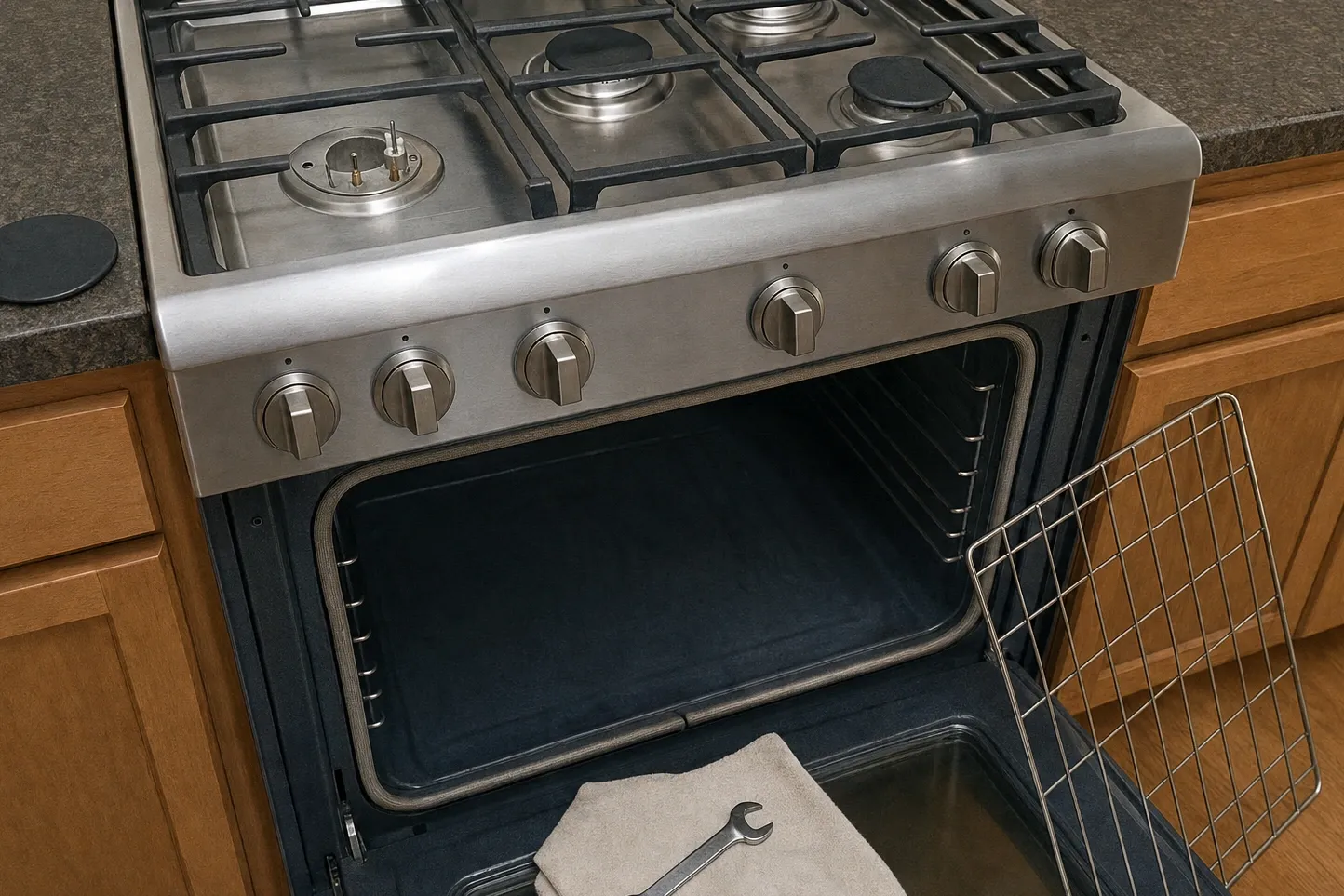
A Viking burner should light with a soft thump and settle into a ring of short blue cones. When one comes up long, lazy and orange at the tips, and the bottom of a saucepan starts wearing a grey-black film after a week, the assumption in the room is nearly always that the range has developed a fault. In this city that is the wrong assumption more often than it is the right one.
What a correct flame actually looks like
Pull the pan off and look at the burner from the side rather than from above. A correctly metered sealed burner gives you cones roughly half an inch tall, blue throughout, with a slightly lighter blue inner cone and no visible yellow except possibly a flicker at the very tip of the outer ring. It should be quiet. It should not lift away from the port, and it should not reach up the side of a pan.
A rich flame looks different in three ways at once: it is taller, the tips are orange or yellow, and it is softer — it moves in the draught from a hood that a correct flame ignores. Soot is the confirmation. Carbon on the underside of a pan means fuel is not burning completely, and fuel does not burn completely when there is not enough air to go round.
Why a mile of elevation changes the burner
Denver sits about a mile above sea level. Air up here is thinner: the same volume carries roughly a sixth less oxygen than it does at the coast. A gas burner does not know that. It has a fixed brass orifice sized to pass a set amount of fuel at a set supply pressure, and it draws its air by entrainment through the shutter as the gas jet passes. Feed sea-level fuel into thin air and the mixture goes rich. You get exactly the symptoms above, and you get them on the high-output burners first because they are the ones asking for the most air.
Manufacturers know this and publish a high-altitude orifice set for the model, along with a shutter setting to go with it. The conversion is not exotic and it is not expensive. It is simply a step that gets skipped — by a builder fitting out a new-build condo at pace, by a delivery crew who set the range in place and left, or by an installer who has always worked at sea level and never had to think about it. Ranges are also moved between houses, and a unit that came from a coastal city arrives here still metered for the coast.
The other altitude-related symptom is the one people mention second: a simmer setting that will not hold. A burner running rich at the top of its range is running at the edge of stability at the bottom of it, so the low setting blows itself out — often when the extraction comes on, which is what makes it look like a random fault rather than a setup one.
What it is not
Before anything gets replaced, the list of things that do not cause a tall orange flame is worth having, because these are what get swapped first by people guessing:
- The spark module. It lights the burner. It has no bearing on how the burner burns once lit.
- The burner cap. A corroded or wrongly seated cap will make a flame uneven, patchy or noisy across the ports. It does not make the whole ring go long and orange.
- The valve. A tired valve affects how smoothly the flame steps down, not the air-fuel ratio at full input.
- The regulator, usually. A regulator set to the wrong fuel — natural gas versus propane — is a genuine cause of a wildly wrong flame, and it does get fitted wrong. But it produces a violently oversized flame on every burner at once, not the gently rich picture that altitude gives you.
- The range itself. A twenty-year-old rangetop that has always burned like this has almost certainly always been wrong, rather than having slowly failed.
There is one non-altitude cause worth taking seriously: anything that has settled into the burner ports. Sanding dust from a floor refinish, plaster dust from a remodel, boiled-over sugar. That makes individual ports burn badly and produces a patchy, spitting flame. It is cleared with a brush and a port pick, not with parts.
What to check before you call
None of this needs tools beyond a torch, and it saves the visit doing work you could have done yourself:
- Look at every burner in turn and note which ones are wrong. All of them, or only the big ones? That single answer separates a setup problem from a burner problem.
- Check whether the flame was ever right. If the range has burned like this since the day it was installed, it is a setup fault by definition.
- Ask whether anything upstream changed — a new meter, a new regulator, propane swapped for natural gas, or a range that moved house.
- Look for soot patterns. On pan bottoms means combustion; on the wall above the backguard means a flame that has been lifting and rolling for a long time.
- Find the rating plate, usually behind the kick panel or under the rangetop, and photograph it. The model and serial decide which orifice set is correct, and nobody can order parts without them.
When it is worth calling someone out
If the flame is wrong on every burner and always has been, this is a bench job on the manifold with a manometer on it: the orifice set changed to the high-altitude spec for your model, the supply pressure verified, and the air shutters reset. That is an hour or so of work, and it is the cheapest thing we do that changes how a kitchen behaves.
Call sooner rather than later if you smell gas at any point, if a flame is lifting clear off the ports, if soot is landing on the cabinetry above the range, or if the burner has begun going out on its own at low settings and you are relighting it repeatedly. The visit is $89, credited in full against an approved repair, and the diagnosis on this particular fault is quick — a pressure reading and a look at the orifice stamping usually settle it before the toolbag is fully open.
Follow-ups
Does every gas range need converting for Denver?
Most sealed-burner ranges built for the US market ship metered for sea level, and manufacturers publish a high-altitude orifice set for installations above roughly 2,000 feet. Denver is well past that. Whether yours was ever converted depends entirely on who installed it — plenty were not.
Is an orange flame dangerous?
A rich flame burns less completely, which means more carbon monoxide in the products of combustion and soot deposited on cookware and cabinetry. It is not an emergency in a ventilated kitchen, but it is a fault worth correcting rather than living with. If you smell gas, stop using the appliance and call.
Can I just open the air shutter and leave the orifices alone?
On some burners a shutter adjustment gets the flame most of the way back. It cannot fix the underlying fuel rate, though, so the burner still runs richer than designed at full input. Shutters are part of the job, not a substitute for the right orifice.